
Author name: Agent ED

Research

Innovative Teaching in the Digital Age: Exploring the Role of Teachers through Pre-Service Teachers’ Lenses

This post summarizes the paper titled ‘Innovative Teaching in the Digital Age: Exploring the Role of Teachers through Pre-Service Teachers’ Lenses’. Click here to read: DOI Step into a modern classroom, and you will notice that the days of static whiteboards and simple textbook lectures are rapidly fading. Today’s educational spaces are alive with interactive media, digital platforms, and adaptive online tools. Yet, amid this technological tide, a fundamental question emerges: What does it actually mean to be a teacher in the digital age? A qualitative study published in the International Journal of Research and Innovation in Social Science (October 2025) explored this evolving identity through the eyes of 42 postgraduate pre-service teachers in Malaysia. When asked to reflect on digital innovation in education, these future educators made one thing clear—teachers can no longer be passive transmitters of pre-packaged content. Instead, they envisioned the modern teacher as an architectural designer of learning. Rather than simply displaying slides or assigning online quizzes, a teacher’s core role is to craft purposeful, interactive, and personalized learning experiences that adapt directly to their students’ unique needs and abilities. Technology alone does not transform a lesson; it is the teacher’s pedagogical creativity that gives digital tools their real purpose. However, translating creative vision into classroom reality requires more than good intentions—it demands robust digital competence and a supportive innovation culture. The pre-service teachers emphasized that digital literacy is no longer an optional add-on, but a fundamental skill for modern teaching. At the same time, they candidly pointed out systemic hurdles: limited internet access, lack of time, and inadequate training can quickly stifle even the most creative ideas. To thrive, teachers need continuous professional learning alongside institutional support that encourages experimentation without fear of failure. Ultimately, the study reveals that true digital innovation in education is not a solitary journey. When teachers collaborate, share digital resources, and engage in active professional learning communities, innovation spreads faster and takes deeper root. By connecting creative design, technological fluency, and peer collaboration, future educators are reshaping teaching into a dynamic, user-driven, and deeply human art form—proving that while digital tools may evolve, it is the teacher’s thoughtful choices that truly shape the future of learning.
Research

STEM with a Conscience: Exploring the Development of STEM Skills and Social Values among Malaysian Students

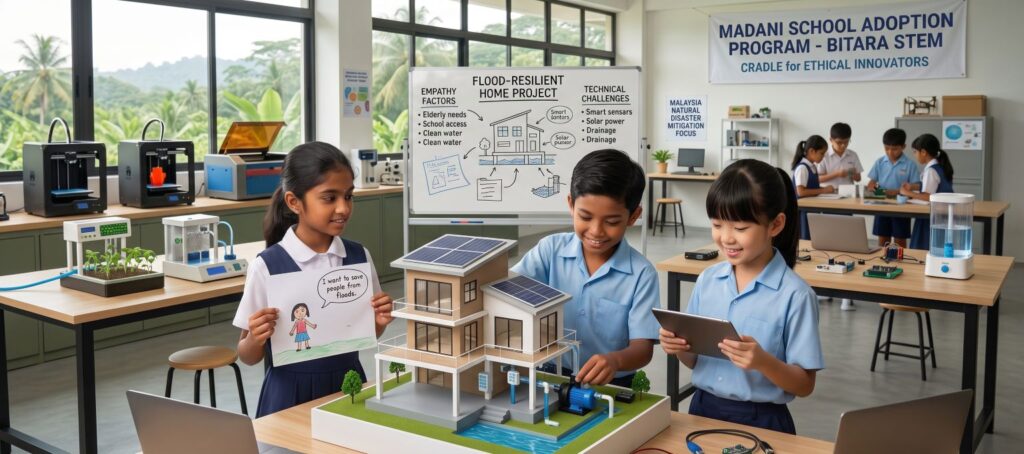
This post summarizes the paper titled ‘STEM with a Conscience: Exploring the Development of STEM Skills and Social Values among Malaysian Students’. Click here to read: DOI Ask any child what bothers them about the world, and you will hear answers full of pure heart: “I want to stop bullying,” “I want to help poor people,” or “I want to save people from floods.” They feel the pain of their communities deeply, yet they often lack the tools to bridge the gap between caring about a problem and actually fixing it. A study titled STEM with a Conscience, published in the International Journal of Research and Innovation in Social Science (Dec 2025/Jan 2026), set out to explore what happens when we give young minds the scientific foundation to turn those compassionate instincts into concrete reality. Focusing on 120 primary school students participating in Malaysia’s MADANI School Adoption Program—BITARA STEM framework, researchers asked them a simple question: “What problem would you like to solve for the benefit of your country or community in the future?” Before joining the program, the children’s written reflections revealed a strong sense of moral responsibility, but their ideas remained abstract and emotional. They knew what felt wrong in society—rising living costs, corruption, natural disasters, and social conflict—but had no tangible blueprint for how a student could ever intervene. Everything changed once the students went through hands-on, project-based STEM learning. As they engaged with scientific concepts, engineering design processes, and digital tools, their focus shifted from helpless empathy to active, analytical problem-solving. The same children who previously wished to “help flood victims” began designing flood-resilient homes and improved drainage systems. Those concerned about high living costs proposed building smart energy-saving systems and solar tech to lower household bills. Even social issues like bullying and dishonesty transformed into technical challenges, inspiring ideas for digital awareness apps and community reporting tools. This evolution captures the core spirit of Value-Based STEM Education (VB STEM)—the belief that science should never be taught in a moral vacuum. When classrooms connect technical skills like critical thinking and technological literacy with humanistic values like empathy and civic duty, learning gains a deeper purpose. STEM education ceases to be a pathway for creating technicians who merely memorize formulas; it becomes a cradle for ethical innovators who recognize that knowledge only truly matters when it is used to serve humanity.

Research

From Theories to Tools: How Design Thinking is Changing the Way We Learn

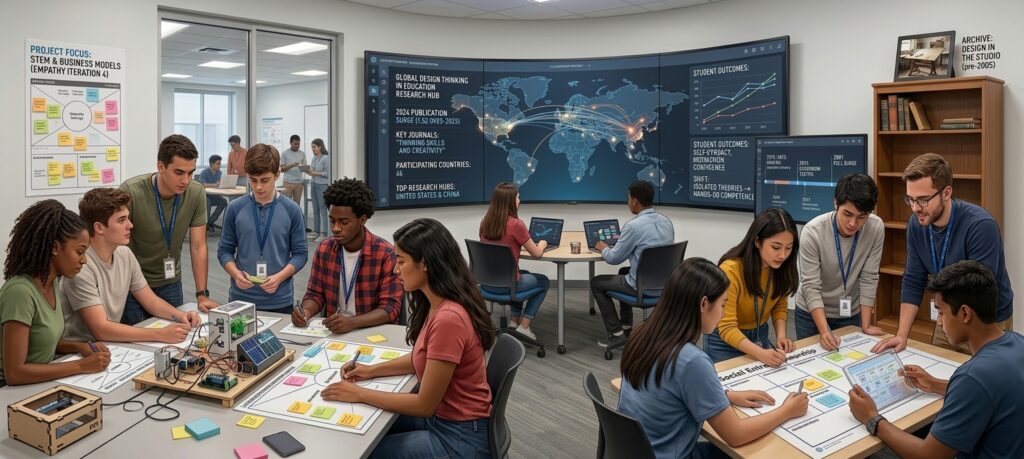
This post summarizes the paper titled ‘Research Focus and Trends of Design Thinking in Education: A Bibliometric Analysis’. Click here to read: DOI There was a time when design was tucked safely away in studio spaces, reserved for architects drafting blueprints or engineers refining physical products. But as classrooms worldwide began grappling with complex, modern challenges, a quiet shift started to unfold. Teachers began asking what would happen if students stopped simply memorizing facts and started approaching real-world problems with the heart of a designer. To understand how this idea grew into a global movement, a recent bibliometric study analyzed two decades of research across 276 academic publications, tracing the journey of Design Thinking as it moved from a novel idea into the mainstream of education. In its earliest days between 2005 and 2015, the story moved slowly, with researchers mostly debating general educational theories and foundational ideas in isolated studies. But around 2016, something sparked as educators began testing design frameworks directly in their classrooms to unlock student creativity. By 2021, that spark became a full surge, culminating in 2024 with a publication output 1.5 times greater than the year before. Led by research hubs in the United States and China—and championed by journals like *Thinking Skills and Creativity*—the conversation rapidly spread across 46 countries, proving that the desire to innovate in education was truly universal. Yet, the true heart of this evolution lies in how the learning itself has transformed. The research reveals a clear shift away from abstract theoretical frameworks and toward hands-on, competency-based education. Instead of just memorizing the five stages of design, students today are applying empathy and iterative prototyping to STEM projects, business models, and social entrepreneurship. Rather than measuring passive listening, researchers are now tracking tangible human outcomes—like student self-efficacy, motivation, and the confidence to tackle open-ended problems without a pre-written answer key. Even as design thinking transforms classrooms, the research reminds us that the story is far from complete. Most studies still take place within single national borders, leaving cross-border collaborations rare and keeping many educators isolated as they fight institutional hurdles on their own. For design thinking to realize its full potential worldwide, international research networks must bridge these gaps and share best practices across cultures. Ultimately, the study paints a hopeful picture of modern education: one where classrooms are no longer places to sit quietly and listen, but active launching pads where students use empathy and innovation to design a better future.

Let’s collaborate to shape the next generation of STEM thinkers

Empowering Future Thinkers

Aras 3, Akademia Siber Teknopolis, Universiti Kebangsaan Malaysia, 43600 UKM Bangi, Selangor

Operating Hours

Monday – Thursday
8.00am – 1.00pm
2.00pm – 5.00pm
Friday
8.00am – 12.15pm
2.45pm – 5.00pm

This site can be accessed using smart devices. Best viewed using the latest versions of web browsers on a minimum resolution of 1024×768

© 2026 mystemup.com. All rights reserved.

Scroll to Top