







This post summarizes the paper titled ‘Design Thinking and Project-Based Learning (DT-PBL): A Review of Literature’. Click here to read DOI
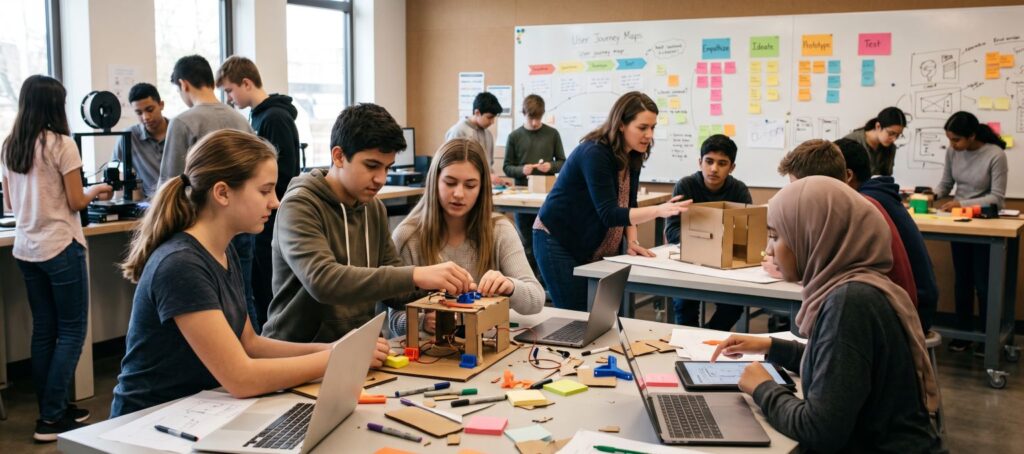
In traditional classrooms, students are often taught to search for the correct answer. Teachers present a question, explain information, and expect students to remember it. But outside the classroom, real-world problems are rarely that simple. Some problems require creativity, experimentation, collaboration, and the willingness to try different solutions. An idea might fail the first time, but that failure can become an opportunity to improve. This is where design thinking and project-based learning come together, offering students a different way to approach learning and problem-solving.
To explore this approach, the researchers conducted a systematic literature review of 14 publications on design thinking and project-based learning (DT-PBL). This study examined how educators could integrate the two approaches, their benefits, and the challenges of implementing them. The researchers also identified two DT-PBL models, showing that this educational approach is still developing and has not yet reached a fully established form.
The findings suggested that DT-PBL could improve students’ creativity, critical thinking, and problem-solving abilities. Through design thinking, students are encouraged to understand problems, explore different possibilities, and develop solutions. Project-based learning then provides opportunities to apply those solutions through practical activities. The study also highlighted the importance of teachers, who must adapt their instructional practices and guide students through this more active learning process. However, the researchers acknowledged that further research is needed to better understand and implement DT-PBL across educational settings.
Ultimately, this study presents DT-PBL as a promising approach that moves education beyond memorization and routine classroom activities. Instead of simply following instructions, students are encouraged to think independently, explore possibilities, and develop creative solutions to meaningful problems. Teachers also have opportunities to improve their teaching through innovative strategies. Education should not only teach students how to understand existing ideas but also give them the confidence and creativity to develop new ones.