







This post summarizes the paper titled ‘Study on the Exploration of Virtual Reality (VR) Technology among Teachers and Students in Perlis’. Click here to read: DOI
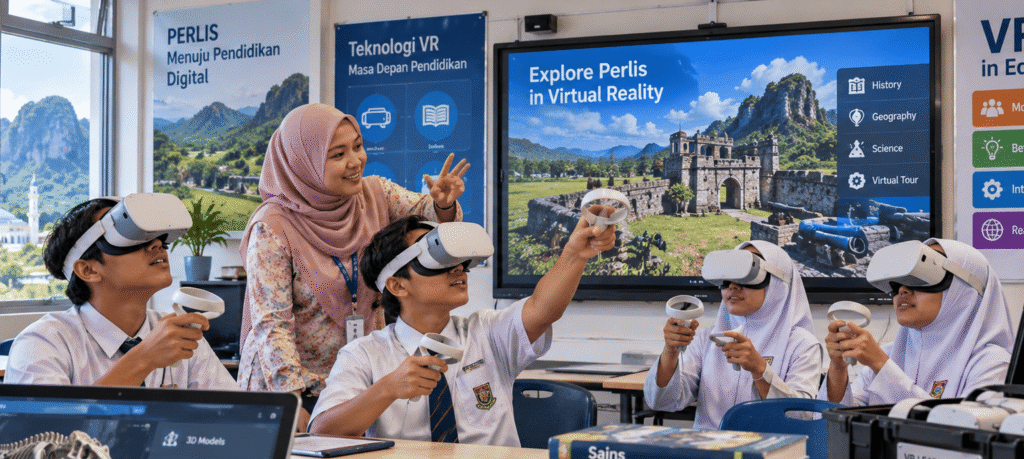
In 21st-century education, Virtual Reality (VR) technology has emerged as a transformative tool capable of creating immersive, three-dimensional digital environments that simulate real-world experience. By enabling hands-on interaction with complex concepts—such as exploring space, performing surgical simulations, or observing molecular reactions—VR significantly enhances student engagement, motivation, and conceptual understanding compared to traditional passive learning methods.
To evaluate the readiness and acceptance of this technology in regional Malaysian education, a quantitative study assessed 90 teachers and students across schools in Perlis using the Virtual Reality Awareness and Knowledge Scale (VRAKS). Findings revealed high enthusiasm and positive perceptions toward VR integration. While 60.7% of respondents reported not using VR comprehensively yet, an overwhelming majority agreed that VR assists in teaching (90.7%) and increases student motivation (94.3%). Statistical analysis (ANOVA) demonstrated strong positive correlations between approval of VR and the intention to adopt it in classroom instruction (r=0.75,p<0.001), with female respondents and complete users showing significantly higher acceptance scores.
Despite the strong willingness to adopt VR, its implementation in Perlis remains limited due to key systemic challenges. Teachers and students identified primary barriers such as a lack of VR devices, high equipment costs, insufficient technical training for educators, and inadequate network and digital infrastructure, particularly in rural schools.
To overcome these obstacles and establish Perlis as a pioneer in immersive education, the study outlines strategic recommendations for policymakers and educational authorities:
- Infrastructure & Equipment: Invest in high-speed internet connectivity, supply subsidized VR sets, and set up centralized VR learning centers for public and school access.
- Teacher Training: Conduct comprehensive training programs and practical workshops to build educators’ confidence in integrating VR into lesson plans.
- Curriculum Integration: Develop localized VR modules tailored to subjects like science, history, geography, and technical/vocational training.
- Strategic Partnerships: Collaborate with local technology companies, universities, and industry partners for software development, equipment sponsorship, and corporate social responsibility (CSR) initiatives.