






This post summarizes the paper titled ‘The development direction and challenges of STEM integration: a systematic literature review’. Click here to read: DOI
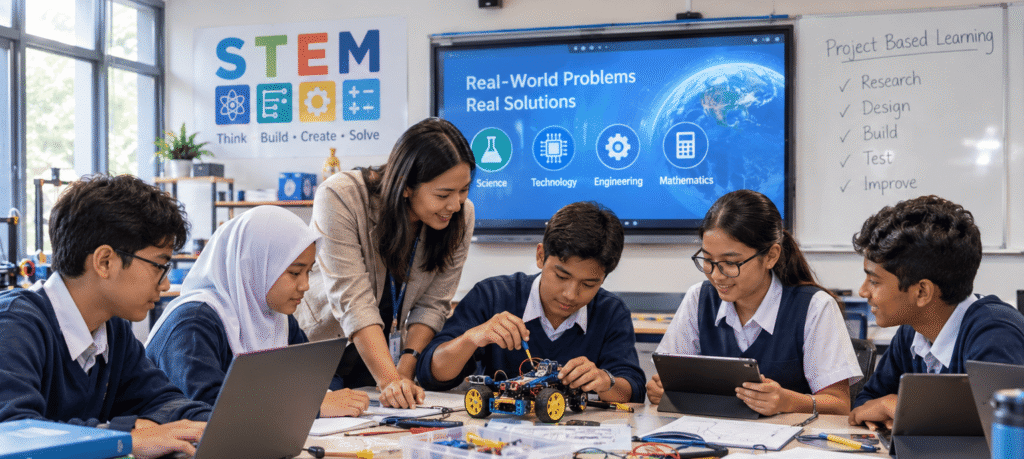
As technology, artificial intelligence, and digital industries rapidly transform the global economy, educational systems worldwide face a pressing challenge: traditional single-discipline teaching is struggling to prepare K-12 students with the complex problem-solving abilities required for modern workforces. To address student disengagement in core subjects like mathematics and science, educators have increasingly championed STEM integration—an approach that breaks down rigid subject boundaries to connect Science, Technology, Engineering, and Mathematics through authentic, real-world learning. A systematic literature review published in the Journal of Education and Learning (2026) analyzed 62 peer-reviewed studies published between 2013 and 2023 from Web of Science to map the development direction, pedagogical approaches, and key challenges surrounding STEM integration in K-12 education.
The review established a holistic, closed-loop framework for K-12 STEM integration comprising six interconnected components: STEM curriculum, STEM pedagogy, STEM projects, STEM models, STEM teachers, and STEM evaluation. Across these areas, the study highlighted several critical trends shaping the future of integrated education:
The STEM curriculum is shifting away from isolated instruction toward interdisciplinary and multidisciplinary frameworks. This integration ranges from correlation fields (aligning standalone subjects around shared concepts) to broad fields integration, where traditional disciplinary boundaries disappear entirely in favor of thematic, real-world projects like robotics or automated systems. Furthermore, STEM boundaries are expanding to incorporate additional domains—such as STEAM (adding Arts), medical engineering, history, and humanities—to foster well-rounded 21st-century skills.
Traditional teacher-centered instruction is rapidly giving way to student-centered learning methodologies. The review identified Problem-Based Learning (PBL), Project-Based Learning (PjBL), and Engineering Design-Based Learning (EDL) as the dominant pedagogical strategies driving effective STEM integration. These approaches actively engage students in authentic research, inquiry, and design processes that deepen cognitive engagement, build research capabilities, and stimulate interest in future STEM careers.
STEM integration models serve as vital bridge mechanisms connecting abstract curriculum goals with practical classroom delivery. These models frequently embed modern technological competencies—such as computational thinking, machine learning, data analysis, and maker lab activities—directly into core K-12 subjects, helping learners solve real-world problems while maintaining active engagement.
Despite positive learning outcomes, the study identified significant hurdles to widespread implementation. Transitioning to integrated STEM requires high levels of cross-subject collaboration among teachers, major structural modifications to traditional school schedules, and extensive professional development. Additionally, the literature reveals a notable gap in research concerning the internal impacts of STEM integration—specifically regarding how integrated curricula directly influence student STEM identity, long-term STEM literacy, and standardized learning outcomes. Addressing these structural constraints and research gaps remains essential to unlocking the full potential of interdisciplinary STEM education.