






This post summarizes the paper titled ‘An Inspection of Learning Management Systems on Persuasiveness of Interfaces and Persuasive Design: A Case in a Higher Learning Institution’. Click here to read: DOI
Learning Management Systems (LMS) are the backbone of modern tertiary education, enabling universities to deliver course materials, facilitate discussions, and track student progress. However, despite their widespread adoption, online platforms frequently suffer from low engagement, student procrastination, and declining completion rates. Rather than incurring high costs by building entirely new systems, evaluating and refining existing platforms through persuasive design—technology intended to intentionally guide and modify human behavior without coercion—offers a far more effective solution.
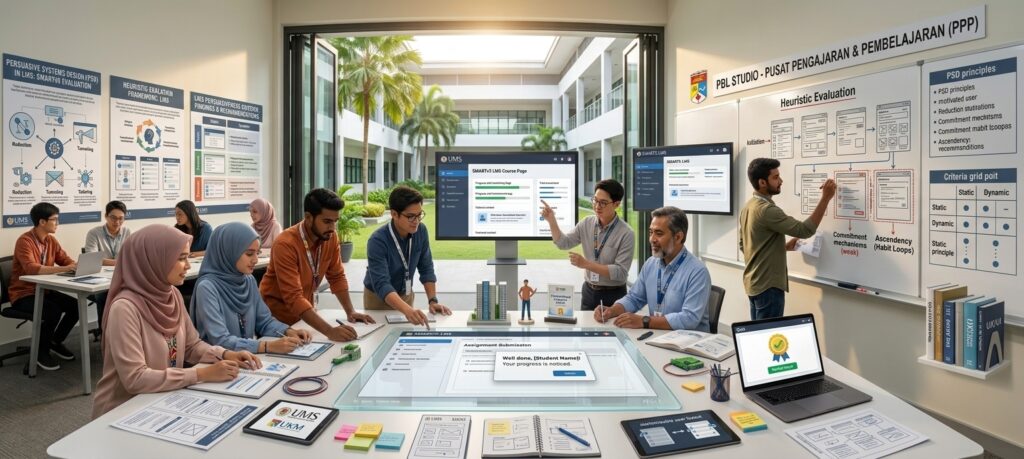
A study published in the International Journal of Advanced Computer Science and Applications(2022) conducted a heuristic inspection of two LMS versions (SMART2 and SMARTv3) at Universiti Malaysia Sabah to evaluate their persuasiveness across six high-traffic screens: the pre-login homepage, course page, assignment view, assignment submission, forum, and quiz views. Guided by HCI and e-learning experts, the evaluation applied two primary frameworks: the Persuasive Systems Design (PSD) model to analyze core persuasion strategies, and a persuasiveness criteria grid (covering static criteria like credibility and privacy, alongside dynamic criteria like initiation and commitment) to assess interface quality.
The evaluation revealed key strengths and areas for improvement across the platforms. Both LMS versions successfully satisfied basic solicitation criteria by effectively initiating user action and scored high in system credibility features, such as displaying institutional logos and authority statements. However, both systems lacked sufficient persuasive design elements in critical interface categories, including attractiveness, personalization, commitment mechanisms, and immediate privacy assurances. Interestingly, while previous educational literature suggested that ascendency (creating habit-forming, regular system usage) was irrelevant for learning platforms, the study found it active across both versions—indicating that mandatory e-learning tools naturally build psychological attachments and repetitive routines among students. Furthermore, the course page interface housed the vast majority of implemented PSD principles, such as reduction, tailoring, and self-monitoring, while other key areas like assignment submission and quiz views remained largely bare of persuasive support.
To bridge these gaps, the authors mapped the six core LMS interfaces to the PSD framework, recommending practical design enhancements such as personalized progress praise, interactive pop-up reminders, customizable user layouts, and rewarding visual triggers. By embedding targeted persuasive strategies across every stage of the student workflow, higher education institutions can transform standard learning platforms into active, engaging digital ecosystems that drive student motivation and academic success.