







This post summarizes the paper titled ‘Understanding Students’ Motivation and Learning Strategies to Redesign Massive Open Online Courses based on Persuasive System Development’. Click here to read: DOI
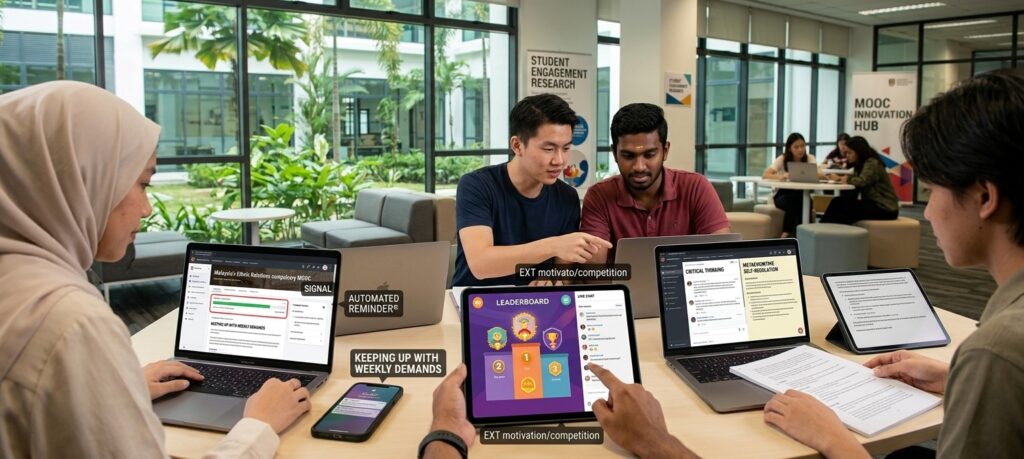
Massive Open Online Courses (MOOCs) have fundamentally transformed higher education by offering flexible, accessible learning beyond traditional classroom walls. Yet, despite their widespread adoption, online platforms frequently struggle to keep students fully engaged. Without face-to-face interaction or immediate peer pressure, learners often feel disconnected, struggle with time management, or lack the motivation to complete open-ended courses. To address these challenges, a study published in the International Journal of Advanced Computer Science and Applications(2019) explored how persuasive technology can be designed into MOOCs to encourage better study habits and boost academic performance.
Focusing on higher education students enrolled in Malaysia’s compulsory Ethnic Relations MOOC, the researchers conducted an empirical study using the Motivated Strategies for Learning Questionnaire (MSLQ). Applying statistical techniques like Automatic Linear Modelling (ALM) and Multiple Linear Regression (MLR), the authors fulfilled the critical first phase of the Persuasive System Design (PSD) framework: uncovering the underlying motivation and learning strategies that directly drive student success.
The results identified six key study behaviors that significantly predict high academic performance:
- Keeping Up with Weekly Demands: High-performing students consistently manage their time to keep up with readings and assignments.
- Regular System Engagement: Logging into the MOOC platform frequently strongly correlates with academic success.
- Metacognitive Self-Regulation: Successful learners actively think through topics to determine what they need to learn rather than passively skim through materials.
- Consistent Exam Preparation: Making time to review notes and readings before assessments prevents last-minute cramming and leads to better scores.
- Critical Thinking: High achievers evaluate assertions, question conclusions, and explore alternative perspectives during their studies.
- Extrinsic Motivation: Healthy competition—such as striving to achieve better grades than peers—serves as a powerful driver for student effort.
By mapping these behaviors to Fogg’s Behavior Model, the study provides a clear blueprint for developers and educators to redesign MOOCs. Rather than relying on static lecture videos and quizzes, future online learning platforms can incorporate targeted persuasive features—such as automated reminders (signals), motivational triggers (sparks), simplified interfaces (facilitators), live chats, gamification, and mobile accessibility. Ultimately, by aligning technology with human motivation and self-regulated learning strategies, online education can move beyond passive content delivery and actively guide students toward academic excellence.