






This post summarizes the paper titled ‘STEM with a Conscience: Exploring the Development of STEM Skills and Social Values among Malaysian Students’. Click here to read: DOI
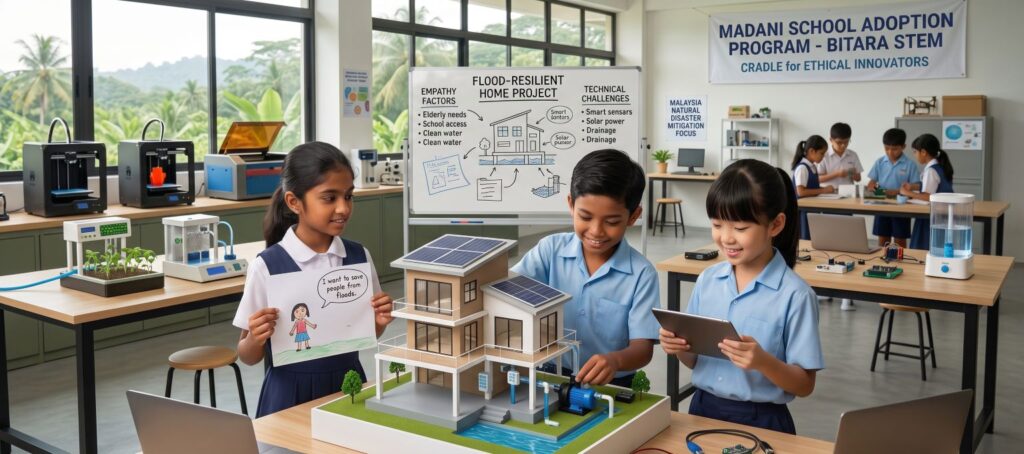
Ask any child what bothers them about the world, and you will hear answers full of pure heart: “I want to stop bullying,” “I want to help poor people,” or “I want to save people from floods.” They feel the pain of their communities deeply, yet they often lack the tools to bridge the gap between caring about a problem and actually fixing it. A study titled STEM with a Conscience, published in the International Journal of Research and Innovation in Social Science (Dec 2025/Jan 2026), set out to explore what happens when we give young minds the scientific foundation to turn those compassionate instincts into concrete reality.
Focusing on 120 primary school students participating in Malaysia’s MADANI School Adoption Program—BITARA STEM framework, researchers asked them a simple question: “What problem would you like to solve for the benefit of your country or community in the future?” Before joining the program, the children’s written reflections revealed a strong sense of moral responsibility, but their ideas remained abstract and emotional. They knew what felt wrong in society—rising living costs, corruption, natural disasters, and social conflict—but had no tangible blueprint for how a student could ever intervene.
Everything changed once the students went through hands-on, project-based STEM learning. As they engaged with scientific concepts, engineering design processes, and digital tools, their focus shifted from helpless empathy to active, analytical problem-solving. The same children who previously wished to “help flood victims” began designing flood-resilient homes and improved drainage systems. Those concerned about high living costs proposed building smart energy-saving systems and solar tech to lower household bills. Even social issues like bullying and dishonesty transformed into technical challenges, inspiring ideas for digital awareness apps and community reporting tools.
This evolution captures the core spirit of Value-Based STEM Education (VB STEM)—the belief that science should never be taught in a moral vacuum. When classrooms connect technical skills like critical thinking and technological literacy with humanistic values like empathy and civic duty, learning gains a deeper purpose. STEM education ceases to be a pathway for creating technicians who merely memorize formulas; it becomes a cradle for ethical innovators who recognize that knowledge only truly matters when it is used to serve humanity.